


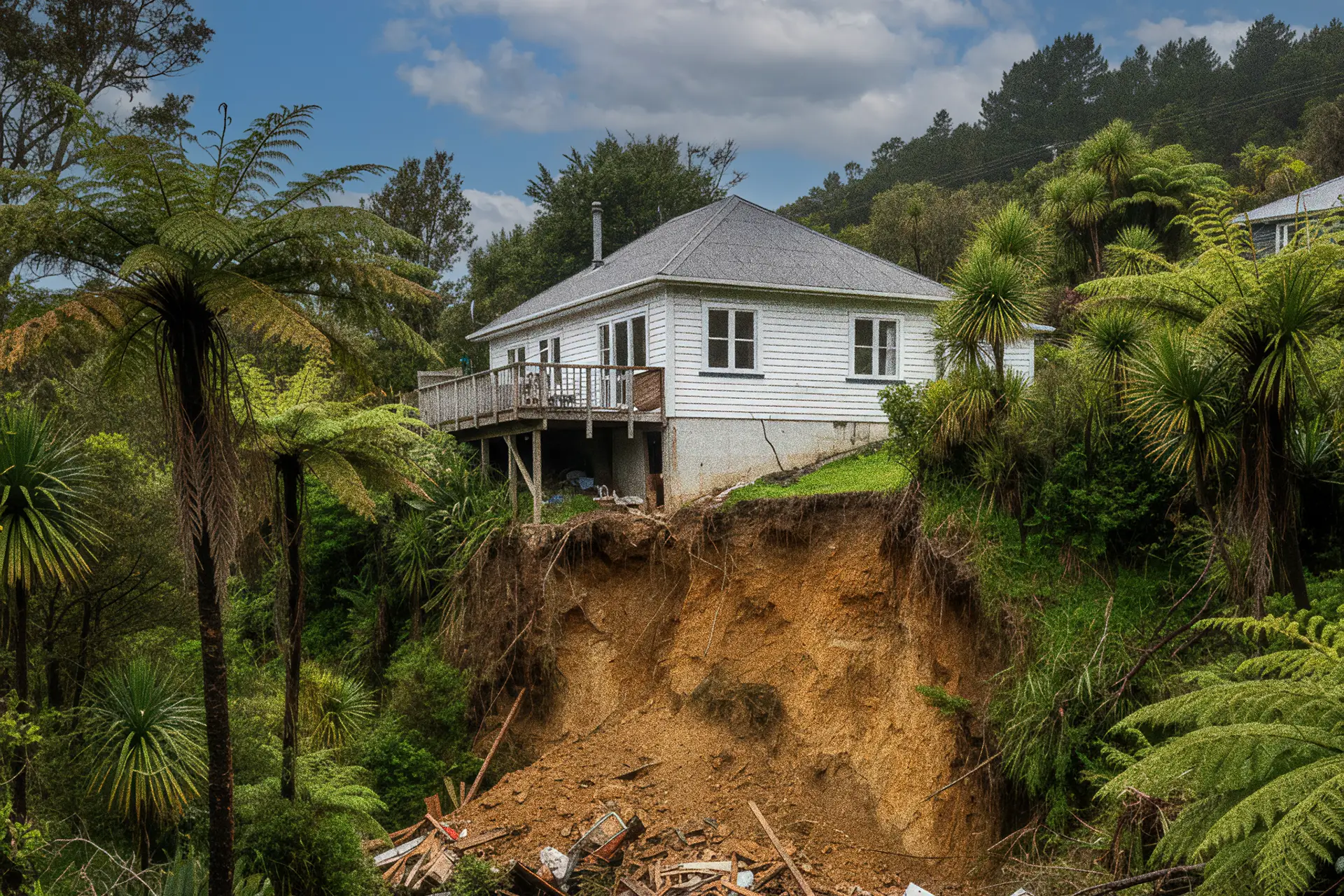
Two recent stories featuring two different District Councils point to a common growing tension: what happens when homeowners believe their local council should take responsibility for land instability or flood risk — and the council disagrees?
In Auckland, councillors are considering a late-stage policy change that could limit access to Category 3 flood buyouts for certain properties, instead increasing the amount that can be spent on mitigation works such as retaining walls or house lifting. Meanwhile, in Thames-Coromandel, homeowners have described long battles with councils over slips originating from council-owned land, with some paying hundreds of thousands of dollars for retaining walls themselves. These cases raise important legal questions about liability, fairness, and the rights of ratepayers when council land or council decisions affect private property.
Flood Buyouts and Policy Shifts in Auckland
Auckland Council is proposing to amend its Category 2P risk mitigation scheme, allowing it to fund up to 40% of a property’s capital value for mitigation works — and, critically, removing the automatic pathway to a Category 3 buyout where mitigation costs exceed 25%.
For affected homeowners, this may mean:
- Being required to remain in a property they would prefer to exit
- Undertaking significant works rather than accepting a buyout
- Facing insurance or valuation challenges
- Applying for “special circumstances” reviews if they disagree
Where councils alter scheme criteria late in the process, legal scrutiny may focus not just on the outcome but on whether the decision-making process was reasonable, consistent, and lawfully exercised.
Slips, Retaining Walls and Council Land
In the Thames-Coromandel and Auckland cases, the issue is slightly different but equally complex: land instability originating from council-owned land impacting private homes
Homeowners have reported:
- Slips occurring on council land
- Damage or risk to private properties
- Being told retaining walls are their responsibility
- Bearing significant financial costs to stabilise slopes
Where council-owned land contributes to instability, the legal framework may involve:
- Negligence principles, particularly if risks were foreseeable
- Nuisance claims, where council land interferes with neighbouring land use
- Statutory duties under the Local Government Act, requiring councils to manage assets prudently
- The adequacy of maintenance or inspection regimes
However, each case turns heavily on facts — including land boundaries, historical alterations, geotechnical evidence, and whether the instability is naturally occurring or exacerbated by infrastructure or drainage.
Common Legal Themes Across Both Stories
Despite differing circumstances, both stories reveal recurring themes:
1. Discretionary Decision-Making
Councils often operate under policy-based schemes, meaning decisions may involve discretion. The legal question becomes whether that discretion was exercised fairly, consistently and with proper regard to relevant evidence.
2. Changing Criteria Mid-Process
Where rules shift after homeowners have already entered a scheme or begun negotiations, affected parties may question whether they have been treated equitably.
3. Evidence and Expert Input
Hydrological reports, geotechnical assessments and engineering evidence can be central in establishing whether a council’s position is defensible.
4. Administrative Law Pathways
If informal engagement stalls, homeowners may consider:
- Formal internal reviews
- Ombudsman complaints (for maladministration or unreasonable delay)
- Judicial review, where the focus is on process rather than the merits of the outcome
- In some cases, civil claims for damage where council assets contribute to loss
Judicial review does not force a council to grant a buyout or build a wall, but it can require the decision to be reconsidered lawfully.
Climate Risk and the Growing Pressure on Councils
Experts have warned that extreme rainfall events are becoming more intense, increasing both flood and landslide risk. As climate pressures grow, councils face financial constraints and policy challenges — and ratepayers may increasingly find themselves navigating disputes over responsibility. The question often becomes one of risk allocation: who should bear the cost when public land and private land intersect under changing environmental conditions?
Wynyard Wood advises homeowners on disputes with local councils involving flood classifications, buyout eligibility, slips, retaining walls and infrastructure impacts. If you are facing resistance from a council and need clarity on your legal position, evidence strategy or next steps, our team can help you assess your options and pursue a fair outcome.
Related Articles:
Construction Contracts Set to Change Under Landmark Building Reforms
Proposed construction law reforms reinforce why clearly drafted contracts are essential for managing risk and allocating responsibility.

When Heritage Buildings are Allowed to Decay What are the Legal Responsibilities
Heritage building disputes raise issues around property maintenance, purchaser due diligence, council obligations, and neighbouring property rights.

How Resident Opposition Can Influence Property Development Outcomes
When large-scale property developments are proposed, it is easy to assume the outcome is already decided. However, a recent case in Mt Albert shows that is not always the reality.
Related Services:

The legal rules surrounding property are constantly evolving. See here for the many ways that we can help.
Read More

Solving disputes for families and businesses: Disputes are an inevitable part of life – it is how you deal with them that counts.